Problem solving · NCERT Class 10
The clue is in the question
A problem is long only when you start in the wrong place. Every problem here asks one thing before any working: where would you look first? Then it shows how the right detail makes the problem short.
26 problems · 9 lenses · every chapter
One problem, marked up
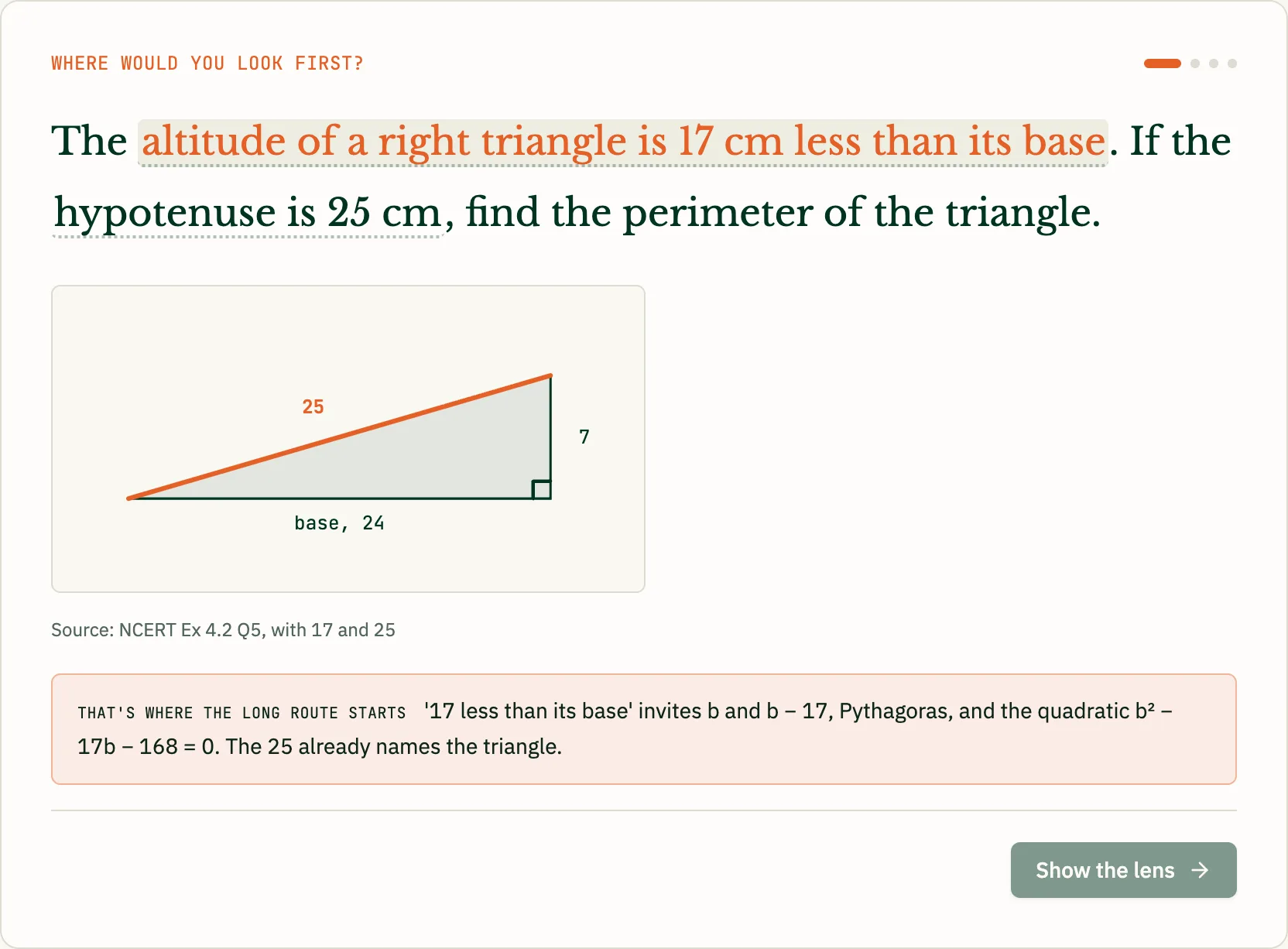
The altitude of a right triangle is 17 cm less than its base. If the hypotenuse is 25 cm, find the perimeter of the triangle.
- The lens
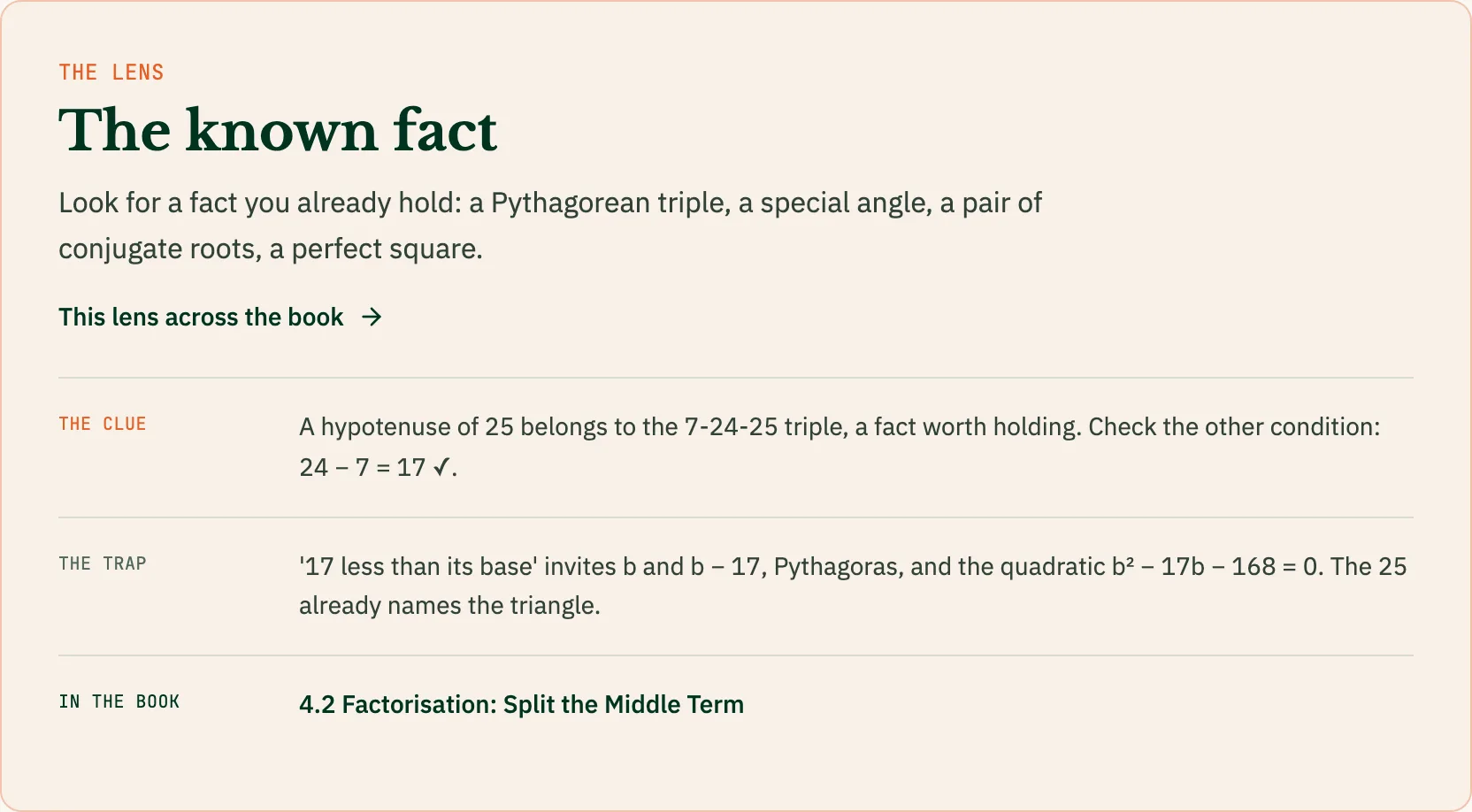
- The known fact. Look for a fact you already hold: a Pythagorean triple, a special angle, a pair of conjugate roots, a perfect square.
The words
Three words, and no others
Every problem page uses the same three words. No methods to memorise, no names for tricks: a clue to find, a lens to look through, a trap to notice.
- The clue
The detail in the question that tells you where to start.
In the problem above
“hypotenuse is 25 cm”. A hypotenuse of 25 belongs to the 7-24-25 triple, a fact worth holding. Check the other condition: 24 − 7 = 17 ✓.
- The lens
A way of looking that works across the whole book. There are nine, each named by what you look at.
In the problem above
The known fact. Look for a fact you already hold: a Pythagorean triple, a special angle, a pair of conjugate roots, a perfect square.
- The trap
The detail that invites the long route.
In the problem above
“altitude of a right triangle is 17 cm less than its base”. '17 less than its base' invites b and b − 17, Pythagoras, and the quadratic b² − 17b − 168 = 0. The 25 already names the triangle.
Inside a problem
Every problem runs the same way
Six parts, one after the other, and nothing else on the page. These are from problem 4.12, the 7-24-25 triangle.
- 1
Where would you look first?
The question, with its details tappable. Tap the clue and it turns green, with the reason. Tap the trap and you are told where the long route starts. Anything else earns a hint, then a stronger one.
- 2
The lens
The way of looking this problem rewards: its name, what to look at, and why the clue and the trap are what they are. Links lead to the concepts in the book it draws on.
- 3
Two routes
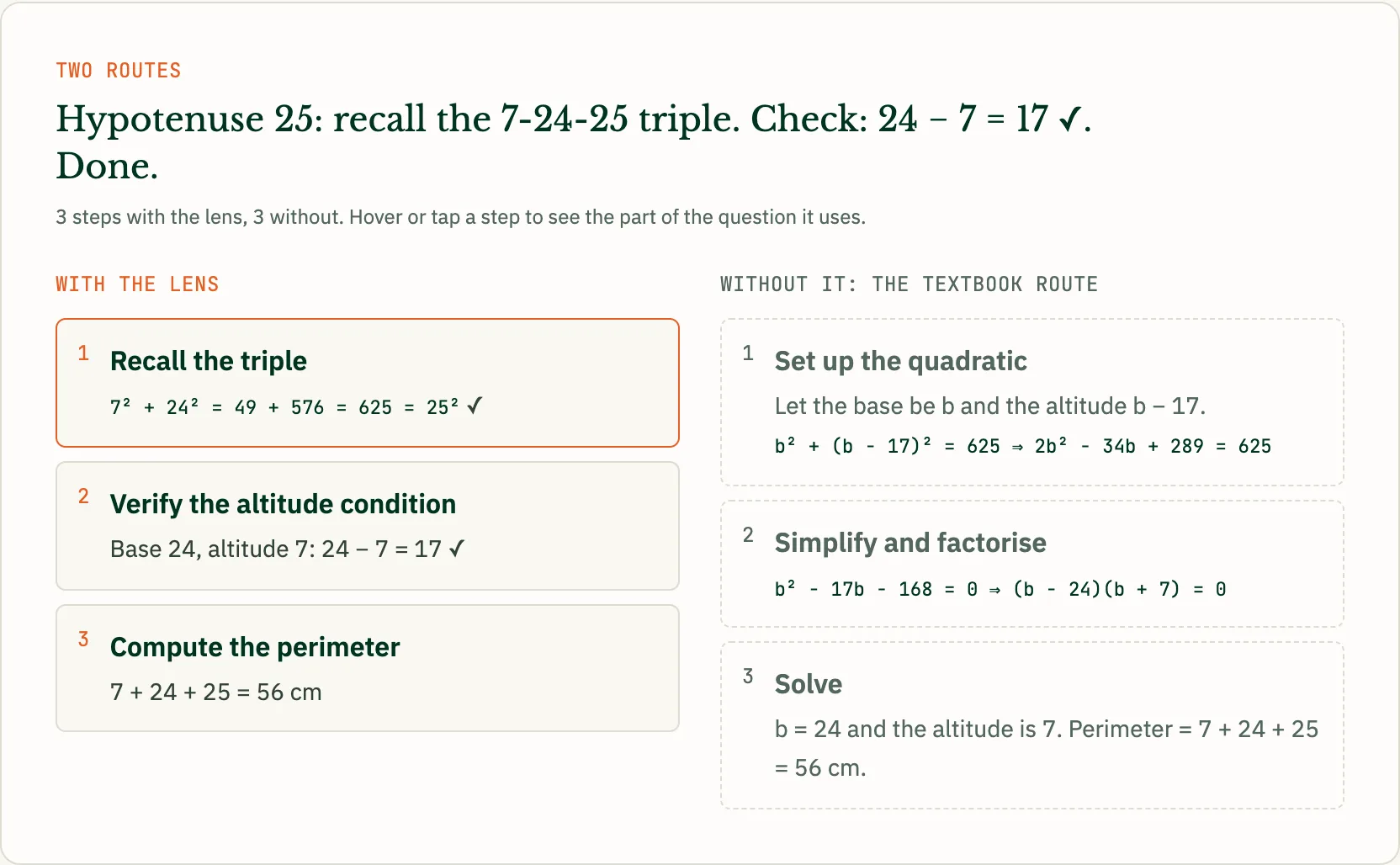
The route with the lens beside the textbook route, step counts included. Hover a step of the short route and the words in the question it uses light up.
- 4
The answer
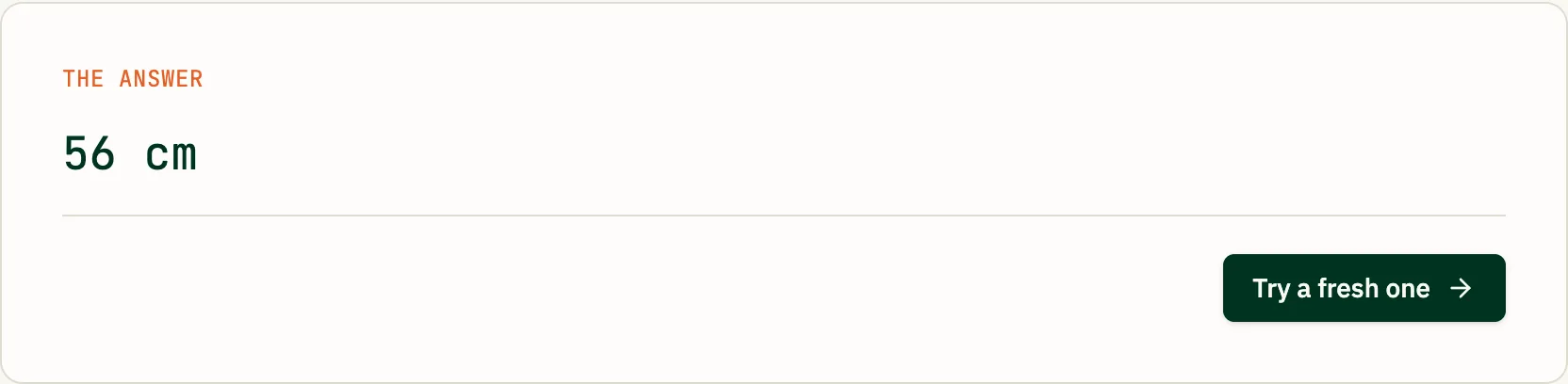
Options to pick, or an answer to reveal, after both routes have been seen.
- 5
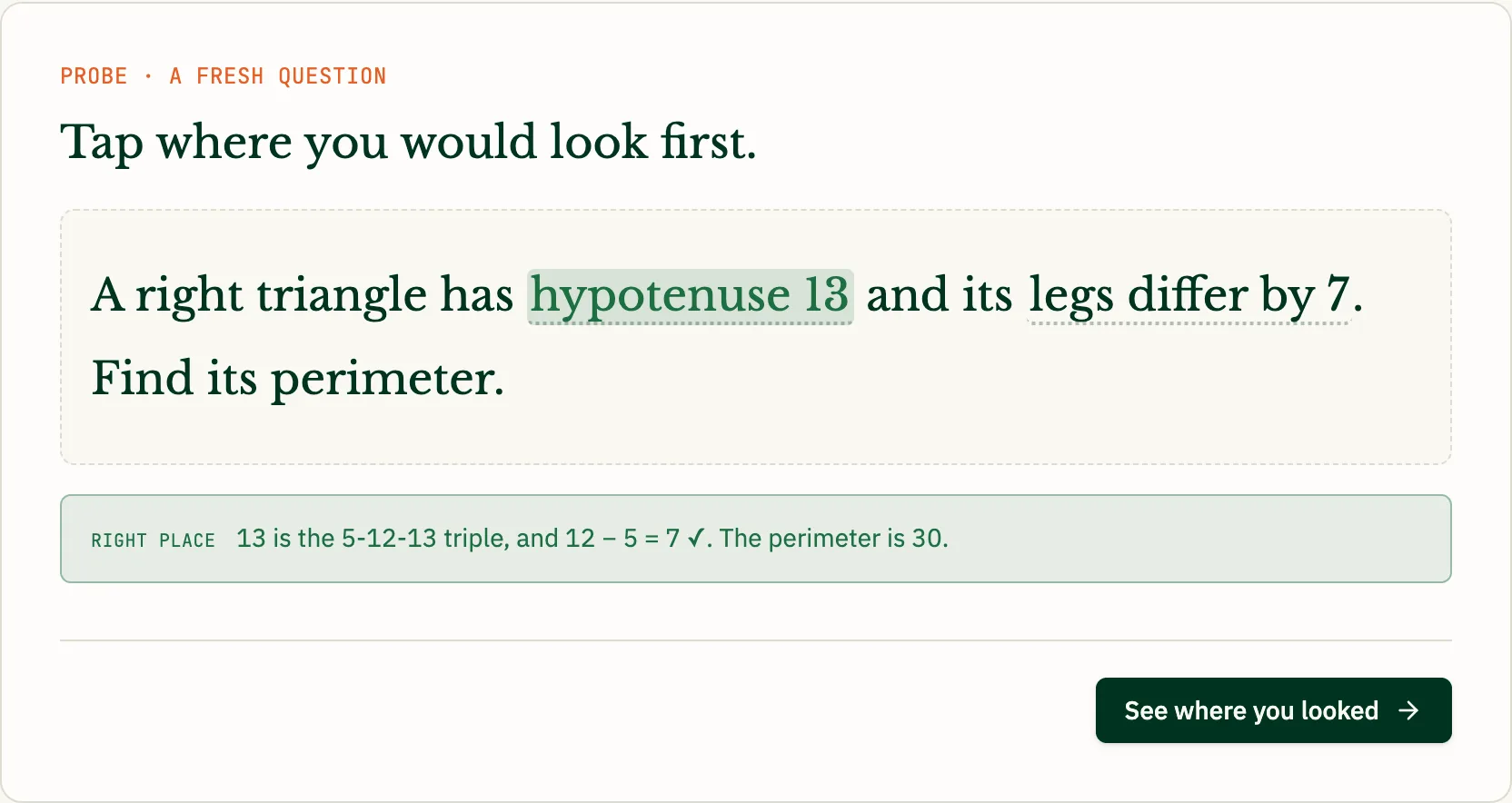
A fresh question
A new question that rewards the same lens, so the habit transfers. Tap where you would look first.
- 6
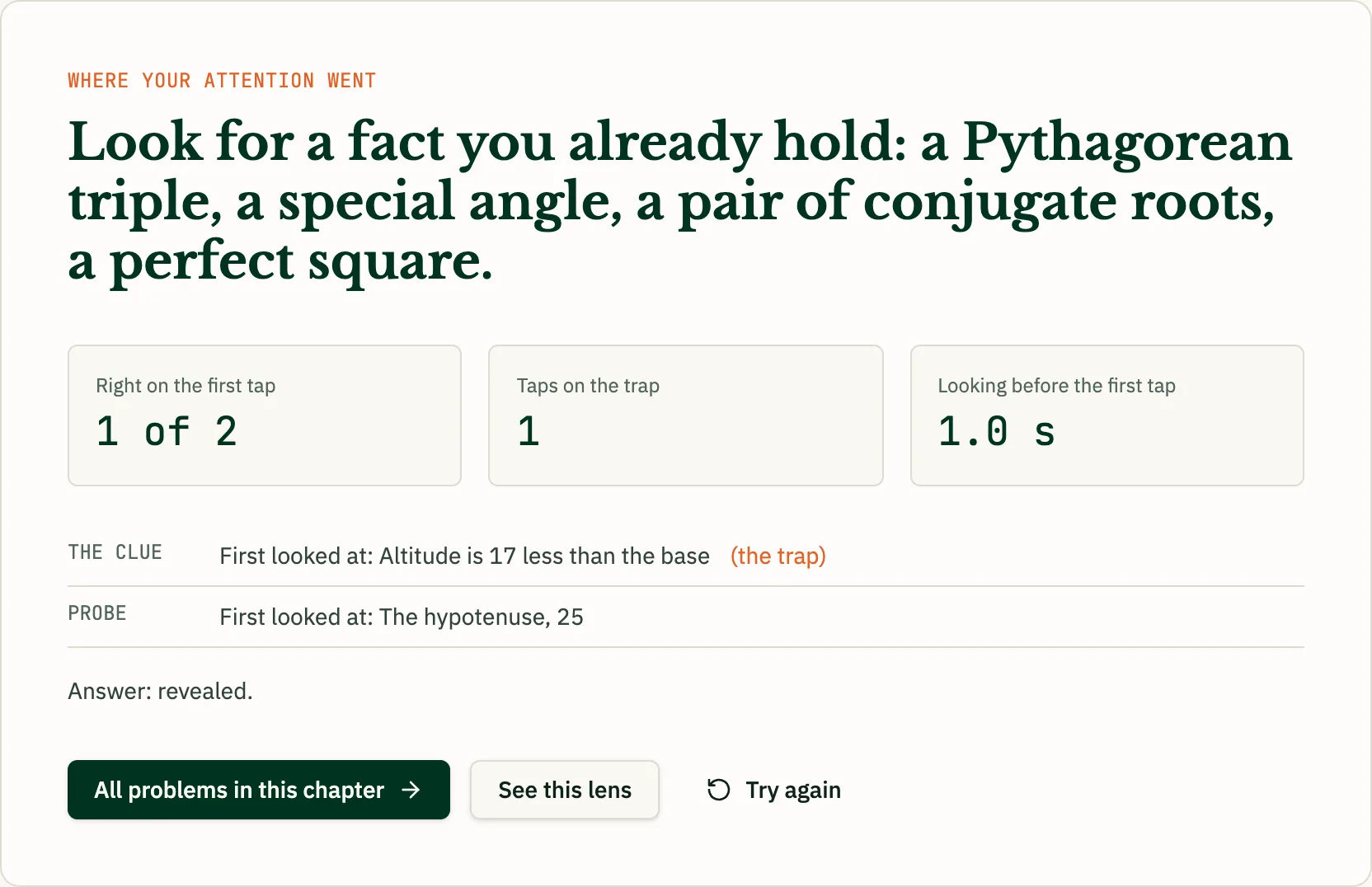
Where your attention went
What you tapped first, how often the trap caught you, and how long you looked before tapping. Then the next problem.
The lenses
Nine ways of looking at a question
A lens is named by what you look at, and the same lens works in different chapters: it shortens a quadratic in Chapter 4 and a probability in Chapter 14. Each lens page has the clues that call for it, a worked example, a quick quiz, and the problems that use it.
- 01The short listLook at the condition that leaves only a handful of candidates. List them, then check the rest.5 problems
- 02The landmarkLook at the number the answer must sit near, or the easy numbers either side of it. Test outward from there.6 problems
- 03The cheap checkLook at a property that rules candidates out before any working: the last digit, parity, sign, size.2 problems
- 04The known factLook for a fact you already hold: a Pythagorean triple, a special angle, a pair of conjugate roots, a perfect square.6 problems
- 05The easy instanceLook at whether the answer depends only on a ratio, or holds for every input. Then use the simplest values.2 problems
- 06The symmetryLook at what stays the same when the variables swap or invert, or when the figure is turned.1 problem
- 07The boundaryLook at the edge case where the answer changes character: D = 0, a = 0, equal ratios, a degenerate figure.1 problem
- 08The optionsLook at the answer choices as data. Test them instead of solving forward.1 problem
- 09The tightest constraintLook at which condition shrinks the answer most. Let it generate the candidates; let the others filter.2 problems
By chapter
Problems in every chapter
In the order of the NCERT book. Each problem sits in the chapter it belongs to and names the concept it draws on.
- 01Real Numbers1 problem
- 02Polynomials2 problems
- 03Pair of Linear Equations in Two Variables1 problem
- 04Quadratic Equations12 problems
- 05Arithmetic Progressions1 problem
- 06Triangles1 problem
- 07Coordinate Geometry1 problem
- 08Introduction to Trigonometry1 problem
- 09Some Applications of Trigonometry1 problem
- 10Circles1 problem
- 11Areas Related to Circles1 problem
- 12Surface Areas and Volumes1 problem
- 13Statistics1 problem
- 14Probability1 problem