NCERT · Class 10 Mathematics
Attention Math
Learning where to look.
Many mistakes in maths happen before any calculation, when your eyes land on the wrong part of the problem. Attention Math teaches the habit of looking in the right place, in two ways.
14 chapters · 56 concepts · 26 problems · 9 lenses
What attention means
Look at (n − 1): it counts jumps, not terms.
aₙ = a + (n − 1)d
- Look here
- The jump count, n − 1. It counts the jumps from the first term. The first term is zero jumps away, so the nth term is n − 1 jumps away.
- Not here
- The position, n. The position n is one more than the number of jumps. Using n gives a + nd, one step too far.
- What it teaches
- Count the moves, not the stops. Off-by-one mistakes come from counting the wrong thing.
Inside a concept
Every concept works the same way
All 56 concepts are built from the same five parts, so once you know one page you know them all. This is concept 10.4, from Circles.
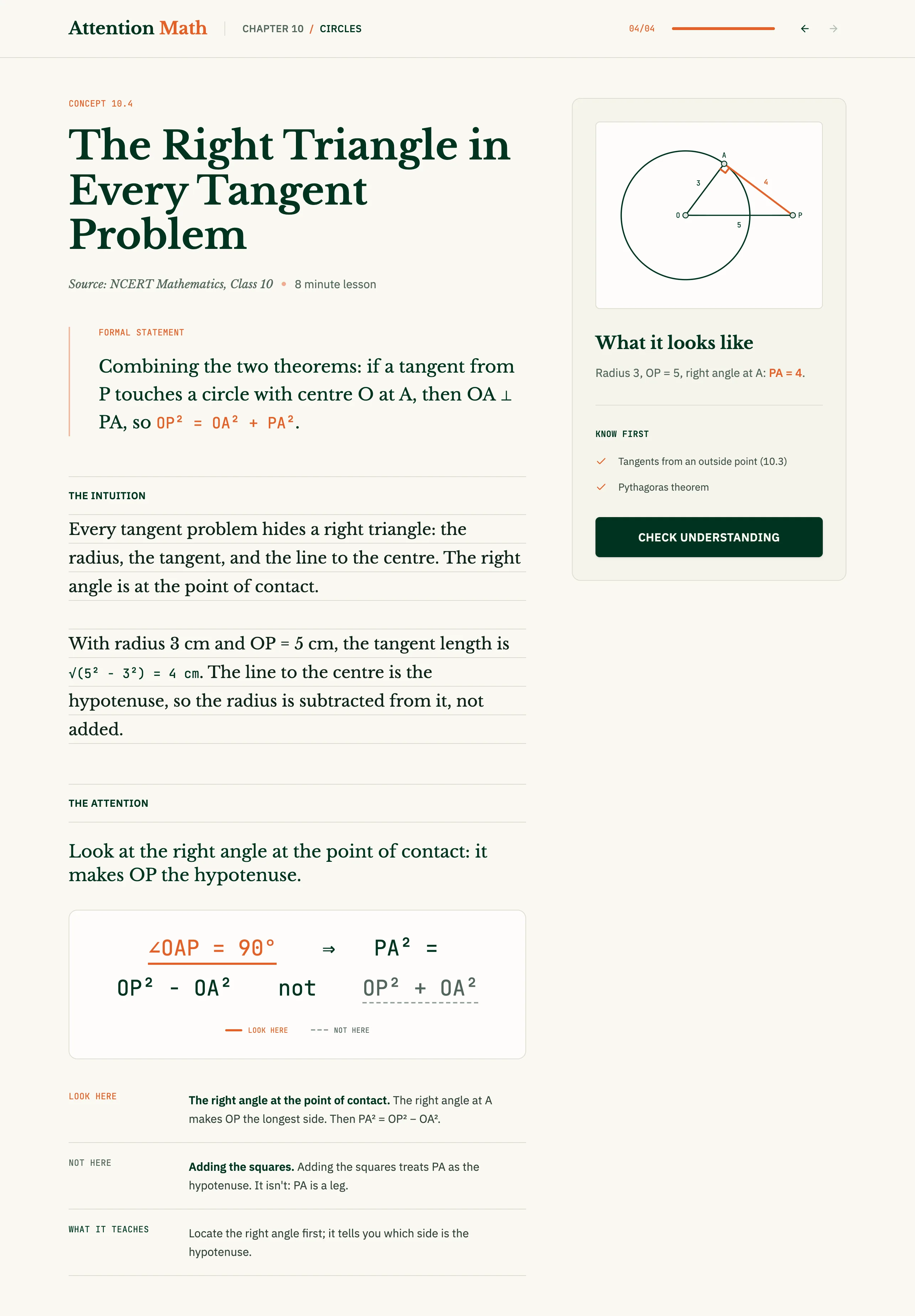
- 1
Formal statement
The NCERT definition, word for word. Nothing is skipped or simplified.
- 2
The intuition
Why it is true, in plain words, on ruled paper.
- 3
The attention
The new layer: where to look, where not to look, and the habit it teaches.
- 4
What it looks like
A diagram drawn from the lesson's own numbers, never a stock picture.
- 5
Check understanding
Tap where you'd look, get a hint or a trap warning, then try a fresh example. At the end you see where your attention went.
Problem solving
The clue is in the question
Every problem has a clue. The clue tells you which lens to use, and the lens makes the problem short. Each problem page asks where you would look first, then shows the route with the lens beside the textbook route.
Three words do all the work: the clue, the lens and the trap. The 9 lenses recur across the whole book, each named by what you look at.
26 problems so far
One problem, marked up
The altitude of a right triangle is 17 cm less than its base. If the hypotenuse is 25 cm, find the perimeter of the triangle.
- The lens
- The known fact. Look for a fact you already hold: a Pythagorean triple, a special angle, a pair of conjugate roots, a perfect square.
The book
Every chapter of Class 10
In the order of the NCERT book. Each card shows a picture from the chapter's first concept.
Chapter 01Number systems
Real Numbers
Primes as building blocks, and the numbers that can't be written as fractions.
4 concepts
Chapter 02Algebra
Polynomials
Degree, zeroes, and how a polynomial's coefficients remember its zeroes.
4 concepts
Chapter 03Algebra
Pair of Linear Equations in Two Variables
Two lines, and the one point (or none, or all) where they agree.
4 concepts
Chapter 04Algebra
Quadratic Equations
Equations with a squared term, and how to read their roots before finding them.
4 concepts
Chapter 05Algebra
Arithmetic Progressions
Lists that change by the same step every time.
6 concepts
Chapter 06Geometry
Triangles
Similar triangles: same shape, any size, and the ratios that prove it.
4 concepts
Chapter 07Coordinate geometry
Coordinate Geometry
Distances and dividing points, read straight off the coordinates.
4 concepts
Chapter 08Trigonometry
Introduction to Trigonometry
Ratios of the sides of a right triangle, named from the angle you stand at.
4 concepts
Chapter 09Trigonometry
Some Applications of Trigonometry
Heights and distances: finding the right triangle hidden in a real scene.
4 concepts
Chapter 10Geometry
Circles
Tangents: the one-point lines, and the right angles they always bring.
4 concepts
Chapter 11Mensuration
Areas Related to Circles
Sectors, arcs and segments: slices of a circle, measured as shares of the whole.
4 concepts
Chapter 12Mensuration
Surface Areas and Volumes
Joining and hollowing solids: what adds, what hides, and what appears.
4 concepts
Chapter 13Statistics and probability
Statistics
Mean, mode and median of grouped data: choosing the right stand-in for each class.
3 concepts
Chapter 14Statistics and probability
Probability
Chances as fractions: count fairly, count the opposite, and check the range.
3 concepts